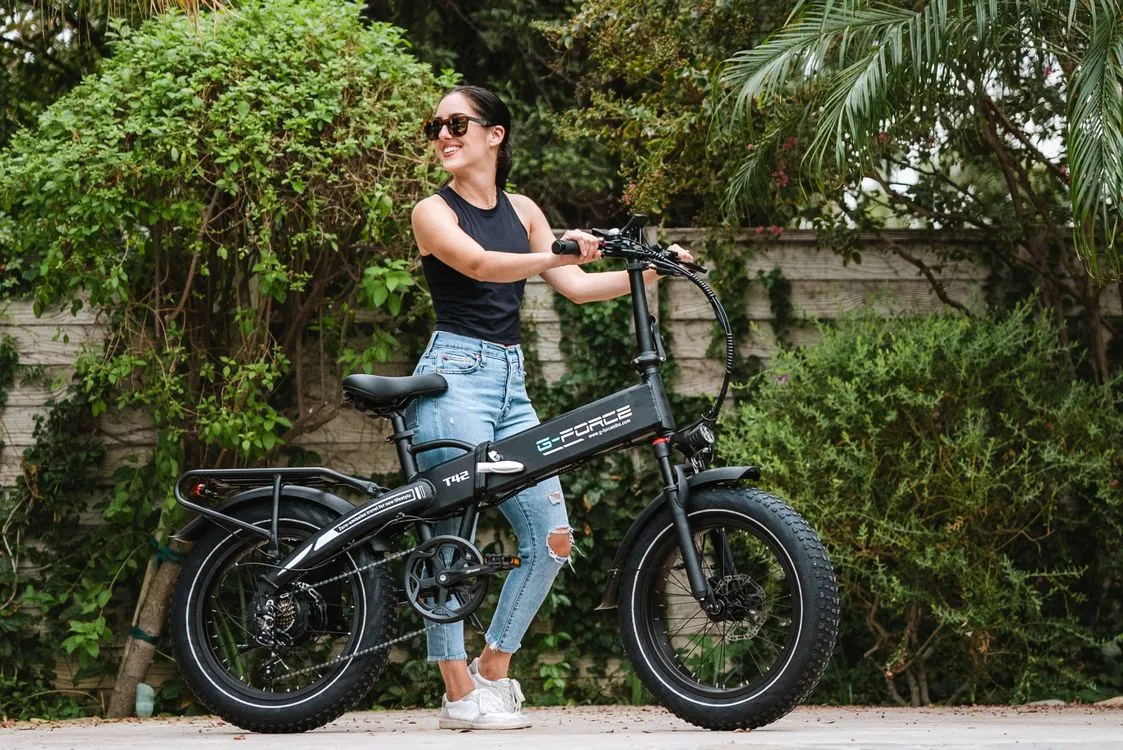
Buying an electric bike is one of the best decisions you can make for your commute, fitness, or weekend adventures - but with hundreds of models across dozens of brands, it’s easy to get overwhelmed.
This guide cuts through the noise. By the end, you’ll know exactly what to look for and which bike fits your life.
Step 1: Define How You’ll Ride
Before looking at specs, be honest about how you’ll actually use the bike.
Commuting
If you’re replacing a car for work trips, prioritize:
- Range (should cover your round trip with 30% to spare)
- Fenders and rack (built-in is better than add-ons)
- Lights (integrated is safer and looks cleaner)
- Lock compatibility (frame design matters)
Good picks: Trek Verve+, Velotric Discover 1, Specialized Turbo Vado
Recreation / Leisure
If you’re riding trails, paths, or just enjoying the outdoors:
- Comfort geometry (upright riding position)
- Suspension (front fork minimum for rough paths)
- Battery range (plan for your longest ride, not average)
Good picks: Aventon Pace 500.3, Lectric XP 3.0, Rad Power RadRover 6 Plus
Note: Rad Power Bikes filed Chapter 11 in December 2025. Verify current dealer and warranty status before purchasing.
Off-Road / Trail Riding
For dirt trails, gravel, or eMTB riding:
- Mid-drive motor (weight distribution and climbing power)
- Full or front suspension (essential for comfort and control)
- Class 1 (most trail access)
- Dropper post compatible
Good picks: Specialized Turbo Levo SL, Trek Powerfly 5, Giant Talon E+
Cargo / Family
If you’re hauling kids, groceries, or gear:
- Payload capacity (know the total weight of rider + cargo)
- Low center of gravity (stability matters when loaded)
- Longtail vs. cargo front (longtails are more common and practical)
Good picks: Tern GSD S10, Rad Power RadWagon 4, Aventon Abound
Note: Rad Power Bikes filed Chapter 11 in December 2025. Verify current dealer and warranty status before purchasing.
Step 2: Set a Realistic Budget
eBikes range from $800 to $15,000+. Here’s what to expect at each price tier:
| Budget | What You Get |
|---|---|
| Under $1,000 | Entry-level hub motors, basic components, cadence sensors. Good for casual use but corners are cut on brakes and drivetrain. |
| $1,000–$1,500 | Hydraulic disc brakes become standard. Quality improves significantly. Best value zone. |
| $1,500–$2,500 | Torque sensors common, better motors, front suspension often included. Sweet spot for serious riders. |
| $2,500–$4,000 | Mid-drive motors (Bosch, Shimano, Specialized), better integration, longer range. |
| $4,000+ | Carbon frames, top-tier components, premium eMTB territory. |
Don’t buy the cheapest bike you can find. A $600 eBike from an unknown brand will likely fail within 18 months and have no dealer support. A $999 Lectric XP 3.0 or $999 Velotric Discover 1 is a much smarter entry point.
Step 3: Hub Motor vs. Mid-Drive
This is one of the most important decisions and one of the most misunderstood.
Hub Drive Motors
The motor is in the wheel hub (usually rear). Simple, affordable, and reliable.
Best for: Flat terrain, casual riding, budget buyers, throttle users
Pros:
- Less expensive
- Less maintenance (no stress on drivetrain)
- Throttle-capable
- Independent of gearing
Cons:
- Heavier in wheel (affects handling)
- Less efficient on hills
- Cadence sensors common at lower prices (less natural feel)
Mid-Drive Motors
The motor is at the crank (pedal area), driving the chain. More sophisticated and efficient.
Best for: Hills, trails, long-distance commuting, eMTB
Pros:
- Better weight distribution
- Uses bike gears (more efficient on hills)
- More natural pedaling feel
- Better for off-road
Cons:
- More expensive
- More drivetrain wear (chain, cassette wear faster)
- Usually no throttle
- More complex service
Our recommendation: If you’ll ride hills regularly or want an off-road bike, get a mid-drive. For flat city commuting or casual recreation, a quality hub drive with a torque sensor is perfectly fine and costs significantly less.
Step 4: Torque Sensor vs. Cadence Sensor
This detail matters more than most people realize for the riding experience.
Cadence Sensor
Detects whether you’re pedaling (yes/no) and applies a fixed motor output. Feels more like an on/off switch.
Feel: Surgy, can feel unnatural. Motor kicks in abruptly when you start pedaling.
Common on: Budget bikes under $1,000, most hub-drive bikes
Torque Sensor
Measures how hard you’re pushing on the pedals and responds proportionally. The motor amplifies your effort.
Feel: Natural, smooth. The bike responds to you - pedal harder, get more help.
Common on: Mid-drive motors (Bosch, Shimano), premium hub drives like Velotric
Our recommendation: If budget allows, always choose torque sensor. It makes a huge difference in day-to-day riding feel. The Velotric Discover 1 at $999 is remarkable for having a torque sensor at that price point.
Step 5: Range - What the Numbers Mean
Manufacturers always show best-case range numbers. Real-world range is typically 40–60% of the maximum claimed range.
Factors that reduce range:
- High assistance level
- Headwinds
- Hills
- Heavier rider
- Cold temperatures
- Throttle use
Rule of thumb: Take the manufacturer’s max range, multiply by 0.6, and that’s your realistic range in moderate conditions.
For a commute, your battery should be able to handle your round trip with 30% remaining. So if you commute 20 miles each way (40 miles round trip), look for a bike with at least 65+ mile stated range.
Step 6: eBike Class
See our detailed eBike Classes Explained guide for full details, but here’s the quick version:
Class 1, 2, 3 Comparison Table
| Feature | Class 1 | Class 2 | Class 3 |
|---|---|---|---|
| Max assisted speed | 20 mph | 20 mph | 28 mph |
| Throttle | No | Yes | Optional (20 mph limit) |
| How motor engages | Pedal only | Throttle or pedal | Pedal only |
| Road bike lanes | ✓ | ✓ | ✓ |
| Multi-use paths | ✓ Usually | ✓ Usually (some trail bans) | ✗ Often no |
| Bike trails | ✓ Most | Sometimes | Rarely |
| National parks | ✓ Where bikes allowed | Sometimes | Rarely |
| Age requirement | None usually | None usually | 16+ in many states |
| Helmet required | Varies by state | Varies by state | Often, all ages |
| Best for | Trail, eMTB, casual | Recreation, limited mobility | Fast commuting |
Laws vary by state. Pair your class choice with your local rules - see our eBike laws by state guide for state-specific requirements.
- Class 1: 20 mph pedal assist, no throttle. Most trail access.
- Class 2: 20 mph, throttle included. Good all-around choice.
- Class 3: 28 mph pedal assist. Best for fast commuting. More road-only.
For most buyers, Class 2 or Class 3 offers the best combination of utility and freedom. Choose Class 3 if speed on roads is a priority; choose Class 2 if you want maximum trail access.
Browse by Class & Use Case
- Class 1 trail/mountain eBikes: Mountain / eMTB category and Best Mountain eBikes
- Class 2 recreational eBikes: Fat Tire category and Best Fat Tire eBikes
- Class 3 commuter eBikes: Commuter category and Best Commuter eBikes
- Cargo eBikes: Cargo category and Best Cargo eBikes
- Folding eBikes: Folding category and Best Folding eBikes
Price Range Cheat Sheet
For more detail, see our full price-based guides:
- Best eBikes under $1,000 - entry-level hub motors
- Best eBikes under $1,500 - best value zone
- Best eBikes under $2,000 - torque sensors + suspension
- Best eBikes under $2,500 - mid-drive territory starts
- Best eBikes under $3,000 - serious commuter/eMTB range
What to Look For - Buyer’s Checklist
- Motor type matches terrain (hub = flat/casual; mid-drive = hills/trail)
- Torque sensor (preferred) or cadence sensor (acceptable at sub-$1,000)
- Battery sized for your round-trip mileage × 1.7
- Class is legal where you’ll ride (check state laws)
- Hydraulic disc brakes (avoid mechanical disc at $1,000+)
- Local service within reasonable distance - use the shop finder
- Weight is manageable if you’ll carry it (stairs, transit)
- Receipt saved in case the federal eBike tax credit passes retroactively
Step 7: Where to Buy
Local Bike Shop (LBS)
Pros: Test rides, in-person service, relationship with mechanics, immediate help if something breaks. Cons: More expensive, limited eBike selection at smaller shops.
Use our shop finder to find eBike dealers near you, filtered by brand.
Direct-to-Consumer (DTC) Online
Pros: Lower prices, often better specs for the money, delivered to your door. Cons: No test ride before buying, limited local service, shipping damage possible.
Best DTC brands: Lectric, Velotric, Ride1UP, Rad Power Bikes, Himiway
If considering Rad specifically, confirm present-day dealer and support coverage in your area before placing an order.
Big Box Retail (Best Buy)
Some brands (Lectric, Rad Power) sell through Best Buy. You can see and touch the bike before buying, but staff expertise is limited and service options are minimal.
Our recommendation: If you’re spending $2,000+, buy from a local dealer for the test ride and service relationship. Under $1,500, DTC brands offer significantly better value.
Common Mistakes to Avoid
1. Buying based on top speed alone. Legal eBike speeds cap at 28 mph. Beyond that, you’re riding an e-moped or illegal eBike. Focus on the riding experience, not spec-sheet speed.
2. Ignoring weight. If you need to carry your bike up stairs or on a train, weight matters enormously. A 65 lb fat-tire eBike vs. a 38 lb commuter is a very different experience.
3. Skipping the test ride. If at all possible, test ride before you buy. Geometry, standover height, and riding position feel completely different in person vs. photos.
4. Forgetting about service. Who will fix it when something breaks? DTC brands without local dealer networks mean shipping your bike for repairs. Factor this into your decision.
5. Underestimating battery size. It’s much better to have range you don’t need than to run out. Go bigger on battery if you’re on the fence.
Our Top Picks by Category (2026)
| Category | Best Value | Best Overall |
|---|---|---|
| Commuter | Velotric Discover 1 ($999) | Trek Allant+ 7 ($3,799) |
| Fat Tire | Lectric XPeak ($1,299) | Velotric Nomad 1 ($1,499) |
| Cargo | Lectric XPress ($1,499) | Tern GSD S10 ($4,599) |
| Mountain | Giant Talon E+ 2 ($2,499) | Specialized Turbo Levo SL ($6,000) |
| Folding | Lectric XP 3.0 ($999) | Tern Vektron S10 ($4,199) |
Frequently Asked Questions
What should I look for when buying an electric bike?
Focus on how you’ll actually ride first: commute, off-road, cargo, or recreation. Then match motor type (hub vs mid-drive), sensor (torque vs cadence), class (1, 2, or 3), and battery range to that use case. Finally, weigh budget against dealer service access - a slightly pricier bike with a local shop is usually the safer long-term buy.
How much should I spend on an ebike?
Under $1,000 gets you an entry-level hub motor with corners cut on brakes and drivetrain. $1,000–$1,500 is the best value zone, where hydraulic disc brakes become standard. $1,500–$2,500 adds torque sensors and front suspension. $2,500–$4,000 unlocks mid-drive motors from Bosch, Shimano, and Specialized. Above $4,000 you’re in premium eMTB territory with carbon frames.
What is the difference between Class 1, Class 2, and Class 3 eBikes?
Class 1 is pedal-assist only up to 20 mph and has the broadest trail access. Class 2 adds a throttle up to 20 mph and is popular for recreation and limited-mobility riders. Class 3 is pedal-assist up to 28 mph for fast commuting and is usually restricted to road bike lanes, not multi-use paths. See our eBike Classes Explained guide for full details.
What electric bike should I buy?
It depends on your use case. For commuting, prioritize range and integrated lights (Trek Verve+, Velotric Discover 1). For off-road, get a mid-drive eMTB (Specialized Turbo Levo SL, Trek Powerfly 5). For cargo or kids, a longtail cargo bike (Tern GSD S10, Aventon Abound). For casual recreation, a budget hub-drive like the Lectric XP 3.0 or Aventon Pace 500.3 is plenty.
Should I buy an ebike from a local shop or online?
Spend $2,000+ at a local dealer for the test ride and ongoing service relationship. Under $1,500, direct-to-consumer brands like Lectric, Velotric, and Ride1UP generally offer better specs for the money, but you lose the in-person service. If you’ll depend on the bike for daily transportation, a local shop is worth the premium.
Ready to find a dealer? Use our shop finder to locate authorized dealers near you.